
Heightened volatility makes the debt rollovers difficult.

It has been a choppy calendar year 2022 (CY22) for global financial markets amid the spectre of rising inflation that led most central banks, especially the US Federal Reserve (US Fed), to tighten their monetary policy. Most equity indices across the globe have seen a sharp fall from their respective peak levels in this backdrop. FTSE India, for instance, has corrected 16 per cent from its October peak.

The Indian rupee on Monday appreciated by 16 paise against the American currency in early trade on hopes of increased capital inflows from foreign funds boosted by last week's rally in the stock markets.

Bajaj Finserv was the top gainer in the Sensex pack, rising around 4 per cent, followed by Bajaj Finance, ICICI Bank, IndusInd Bank, Tata Steel, Axis Bank, HDFC and SBI. NSE Nifty rose 36.55 points or 0.31 per cent to 11,971.05.

On Friday, the rupee had risen 20 paise to settle at 1-1/2 week high of 67.32.

It is looking out for new markets to increase exports.

Maruti was the top loser in the Sensex pack, shedding around 3 per cent, followed by L&T, IndusInd Bank, Axis Bank, ONGC, Reliance Industries, Asian Paints and HDFC. On the other hand, HCL Tech, TCS, Sun Pharma and Tech Mahindra were among the gainers.

Godrej Consumer Products (GCPL) reported 6 per cent year-on-year (Y-o-Y) consolidated net revenue growth in Q4FY24 to Rs 3,385 crore and this was impacted adversely by currency movement. The constant currency (CC) growth would have been 30 per cent Y-o-Y in Q4FY24. India business clocked 12 per cent Y-o-Y revenue growth (5 per cent of it organic) with volume growth of 15 per cent Y-o-Y (7 per cent organic).
.jpg)
RBI's forex swap window for oil marketing companies addresses an urgent issue but what happens when the dollars have to be returned?
RBI Deputy Governor K C Chakrabarty said the central bank will come out in June with its next financial stability report, which showcases the country's financial strength, and

HUL was the top loser in the Sensex pack, shedding around 3 per cent, followed by Tata Steel, Infosys, Maruti, IndusInd Bank, L&T, Asian Paints and TCS.

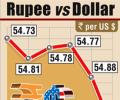
Falling for the second day, the rupee on Thursday weakened by 14 paise to close at 54.46 tracking losses in Indian stocks amid sustained dollar demand from importers.

The rupee appreciated for the second straight day to close 14 paise higher at 54.54 on optimism that government would get Parliamentary approval to FDI in multi-brand retail, leading to big inflow of dollars.
Forex dealers said weakness in local equities and a firm dollar overseas against other currencies also weighed on the rupee.

Bharti Airtel was the top laggard in the Sensex pack, tanking around 8 per cent, followed by Tata Steel, IndusInd Bank, NTPC, PowerGrid, ONGC and TCS. On the other hand, Axis Bank, HUL, Infosys, Nestle India and HDFC Bank were among the gainers.

HCL was followed by Tech Mahindra, Asian Paints, Bharti Airtel, HDFC Bank, L&T, TCS, M&M, Nestle India and Infosys. NSE Nifty rose 23.75 points or 0.20 per cent to 11,896.80.

Axis Bank was the top loser in the Sensex pack, shedding over 4 per cent, followed by Tata Steel, SBI, NTPC, Bharti Airtel, ITC and ICICI Bank.

IndusInd Bank was the top gainer in the Sensex pack, rallying over 4 per cent, followed by Bharti Airtel, Axis Bank, ICICI Bank, Bajaj Finance, Sun Pharma, HDFC and Kotak Bank. On the other hand, Titan, Maruti, ITC, Asian Paints, HCL Tech and Bajaj Auto were among the laggards.

Due to weakness in domestic equities and strong dollar demand, rupee shed its month and a half high against follar.

The rally is being fuelled by across-the-board buying.

Strengthening of euro against the dollar in overseas market and a higher opening in the equity market supported the rupee.

The US dollar index, which tracks the greenback against a basket of six major currencies, was 0.38 per cent lower at 95.41.

Bearish domestic equities restricted the rupee rise.

Mumbai-based Weizmann, part of a diversified group, will take to court its former partner Western Union Holdings, the American money-transfer giant, alleging that the United States-based company has imitated its trademark and logo. This, its lawyers say, constitutes a case of infringement and dilution of its intellectual-property rights.

The Reserve Bank of India (RBI) has announced a dollar-rupee two-year sell-buy swap auction for $5 billion on March 8, which will suck out rupee liquidity from the system. The swap will be in the nature of a simple sell/buy foreign exchange from the RBI side, in which a bank will buy US dollars from the central bank and simultaneously agree to sell the same amount of US dollars at the end of the swap period. "With a view to elongating the maturity profile of its forward book and smoothen the receivables relating to forward assets, it has been decided to undertake sell/buy swap auction of $5 billion on March 8, 2022," the RBI said in a statement. The auction cut-off will be based on the premium amount in paisa terms up to two decimal points.

Extending losses for the third straight session, the rupee today lost 28 paise to end at an over one-week low of 53.50, due to sustained dollar demand from importers amid sluggish local stocks.

Sustained foreign funds did manage to arrest the fall to some extent.

Forex dealers said sustained foreign fund flows also aided the trading sentiment in rupee's favour.

On the Sensex chart, L&T, ONGC, HCL Tech, NTPC, Axis Bank and Infosys were major gainers. NSE Nifty ended with a gain of 18.10 points at 14,956.20.

'This is a good time to restructure your portfolio because the sectors and stocks that performed in the last bull market may not perform as much now.'

Forex dealers said a firm rise in local equities and sluggish dollar overseas also boosted the sentiment in rupee's favour.

Forex dealers said firm local equities, signs of consistent capital inflows and sustained dollar selling by exporters also boosted the rupee sentiment.

The rupee strengthened by 36 paise to 54.48 against the US dollar in early trade today at the Interbank Foreign Exchange on selling of American currency by exporters and banks.

The rupee gained 11 paise to 82.68 against the US dollar in early trade on Tuesday as the American currency retreated from its elevated levels. Forex traders said sustained foreign fund outflows weighed on the local unit and restricted the appreciation bias. At the interbank foreign exchange, the domestic unit opened at 82.69 against the dollar and marginally rose to 82.68, registering a rise of 11 paise over its previous close amid a positive trend in domestic equities.

Continued dollar selling by exporters and some banks on hopes of further fall in dollar value overseas also aided the rupee rise.

The rupee fell by 34 paise to 55.99 against the US dollar in early trade at the Interbank Foreign Exchange market today as the American currency gained against other currencies overseas.

Other prominent gainers included Tata Steel, Sun Pharma, Infosys, Tech Mahindra, IndusInd Bank, HCL Tech, ICICI Bank, HUL and HDFC Bank. NSE Nifty rose 86.40 points or 0.76 per cent to close at 11,503.35.

HCL Tech was the top gainer in the Sensex pack, rising around 4 per cent, followed by Kotak Bank, Infosys, Reliance Industries, UltraTech Cement and Tech Mahindra. On the other hand, Titan, Sun Pharma, ICICI Bank, Axis Bank, SBI and Bajaj Finance were among the main laggards.
The rupee closes 12 paise down against the dollar.

The rupee on Monday dropped by 30 paise to 54.72 against the US dollar in late morning trade, due to on fresh demand for the American currency from banks and importers despite a weak global trend.
